


Workplace stress brought on by the general December frenzy can be enormous at the end of the year, so it is important to recognise it, know our limits and respect them. Below, we have listed a few simple activities that some members of the FirstClass team practise regularly and can confirm work.
1. Prioritisation
When we have an enormous number of tasks on our plate, it is very important to know how to prioritise them. One of the better techniques here is the Eisenhower matrix, which divides tasks into four groups. At FirstClass, we recommend reviewing your matrix every morning and preparing it for the day ahead.
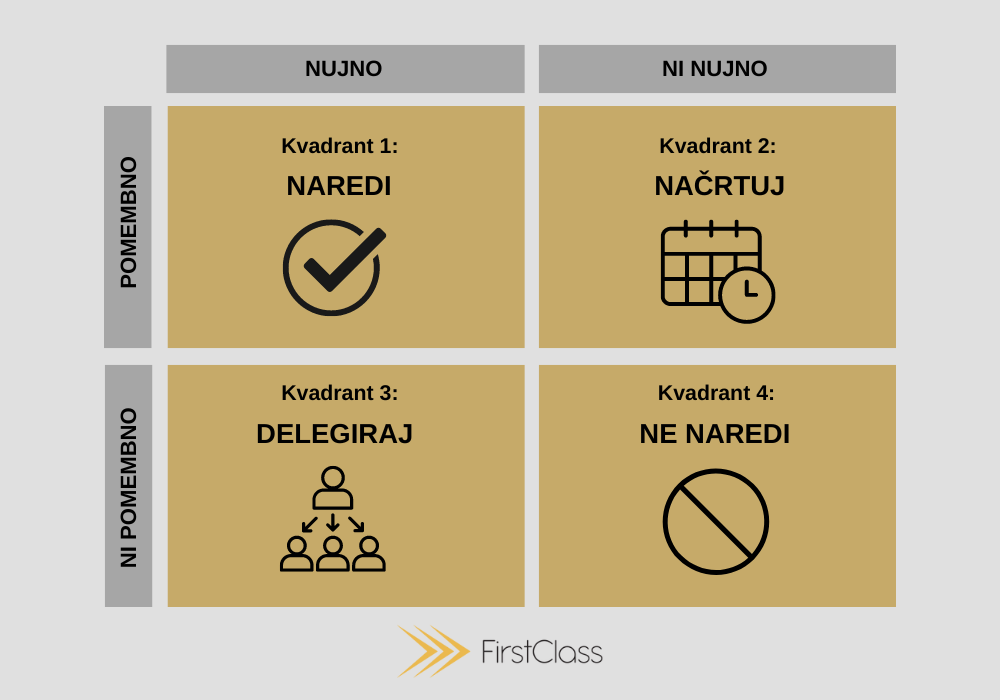
Quadrant 1 – Crisis management
These tasks are important and urgent, as they resolve a crisis. Work done here is usually of lower quality, as decisions and solutions are reached in a hurry (due to time constraints).
! If this quadrant grows bigger day by day, we can quickly burn out.
Quadrant 2 – Planning for the future
While crisis situations cannot be avoided entirely, carefully planning work in line with long-term goals will involve fewer critical and urgent elements.
Our nature leads us to prefer dealing with urgent tasks while putting off important ones.
Quadrant 3 – Delegate to the team
Our short-term focus draws us towards priorities set by others, which can leave us feeling that we are losing control of ourselves because we have to fulfil others' expectations. Mistakes can quickly arise as we treat work that is unimportant to us as important and carry it out as “crisis management”.
! Distinguishing important from unimportant tasks requires us to set our own priorities regularly.
Tasks in this quadrant are an excellent opportunity to entrust the team with more responsibility and empower them to make decisions independently. This kind of delegation not only frees up our time for tasks requiring careful planning (quadrant 2), but also builds trust with other team members.
Quadrant 4: Remove the clutter
Let us distinguish tasks that are useful and will bring genuine added value from those that merely give us a comforting sense of being busy and important, but are actually neither important nor urgent for us or the company.
Let us learn to say no to tasks (first to ourselves and then to others) that are not urgent and do not align with your team's and company's goals. These unimportant, non-urgent tasks are a waste of time that can distract you from delivering real value to your organisation and colleagues.
2. Reflection
During periods when we are particularly busy and burdened with numerous tasks, it is crucial to take a few minutes each day to reflect on the day just gone. The aim is to consider key events and progress, whether we are satisfied with the results and how we achieved them, and whether we might do anything differently if we had another chance.
If we are satisfied with the day just gone, it is crucial to acknowledge this and tell ourselves out loud that we are pleased with ourselves and have done a good job. If we realise we would do something differently, let us consider how we could do it differently the very next day, and then do so.
3. It is acceptable to say no
Saying no to unwanted tasks can be difficult, but it is an important skill to have. We are sharing a few tips on what to do when faced with a task we do not have time for and that will not bring us added value.
- Consider the task carefully. Take some time to think about the task and why you do not want to do it.
- Communicate your reasons for declining the task. Be honest and direct, but also respectful and considerate of the other person's feelings.
- Offer an alternative solution. If you cannot take on the task, try suggesting someone else who could help, or offer to help in another way if possible.
- Stick to your decision. Do not let the other person pressure you into accepting a task if you genuinely do not want to do it. It is perfectly acceptable to say no politely and firmly, and thank them for thinking of you.
Remember that it is perfectly acceptable to turn down tasks that do not align with your priorities or would add to an already full schedule. By saying no, you can protect your time and energy and focus on the things that matter most to you.
4. Time for a break
Take breaks and make time for yourself: it is important to take time for a break at work, as this replenishes our energy, reduces stress and, in the long term, also prevents burnout, increases productivity and improves our overall wellbeing.
All these effects bring equally positive benefits to the companies we work for, as opportunities for employee breaks help improve morale and productivity, also reflected in reduced absenteeism and increased job satisfaction.
The frequency of breaks naturally depends on individual needs and the type of work we do. Some people may benefit from more frequent short breaks, while others may take fewer but longer breaks. It is important to find a balance that suits us and enables us to recharge and refocus throughout the day.
5. Get out into nature
Spending time in the fresh air has been shown to help reduce stress and improve overall wellbeing. Fresh air is full of negative ions, which can positively affect our mood, help improve concentration and reduce fatigue.
In addition, being outdoors can increase our exposure to natural light, helping regulate our body's circadian rhythms and improve our sleep. It also provides a change of scenery and a distraction from the stressors of everyday life, helping refresh our minds and reduce feelings of stress.
Many members of the FirstClass team use these activities to manage their own stress, which often builds up in December due to pressures associated with achieving the final results of the year. We are confident they can help you too.
Bonus idea: This is an excellent time to go on a spontaneous hike in the snow with your colleagues and use it as an opportunity to connect. Over a glass of mulled wine, laughter and a pleasant atmosphere can help you relax even further!